|
StomaPhyx and revisions in general |
Summary of results:
Bottom line: the only revisions which give you a lot of weight loss, do it by making you very sick so that you cannot eat. Most folks would rather have the weight gain than be slimmer and sick. More Details - Stomaphyx and Rose procedures The ASBMS admitted that the reason they do the stomaphyx and rose procedures is because a goodly number of gastric bypass patients regain all or most of their weight (one study found 34 percent of patients who started with a BMI of over 50 regained a lot of weight after a few years). (REF: Annals of Surgery. 244(5):734-740, November 2006. Christou, Nicolas V. MD, PhD; Look, Didier MD; MacLean, Lloyd D. MD, PhD) Revisions are major surgery and generally only give you a 30 lb weight loss. Most surgical sites DO emphasize that you need to diet and exercise with WLS just like Weight Watchers or any other tool, plus you need to keep up your frequent bloodwork check and supplement a LOT.
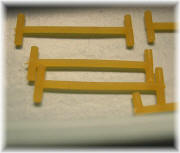
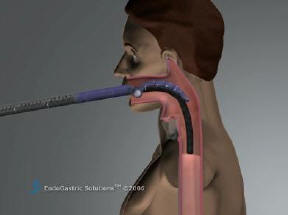
The stomaphyx and Rose procedures are serious surgery but because they are done through the mouth and have no incision, they are called "non invasive". That just means there is no incision with these surgeries. The stomaphyx and the Rose procedure are similar. In both of them, the surgeon sticks a surgical instrument down your throat through your esophagus and into your pouch. Then he makes a bunch of pleats in your pouch, fastening them with either pins (similar to those pictured below - remember the buttoneer?) or sutures (stitches). He can make from 30 to 50 pleats.
You can see the stomaphyx in action in the picture below.
Additionally, they have found that often, neither the stomaphyx nor the Rose last more than a year probably because the tissue they are pleating is very soft and the sutures or pins can pull out. What they don't tell us but what is a no brainer is that
these procedures can perforate the pouch and that might be serious in
terms of leaking stomach acid to your abdomen or worse. That's because what they don't tell you, is after a
gastric bypass you have to go on a very low calorie diet and many people
cannot live well on that. Also many people don't have much energy if
they are not absorbing vitamins. Finally when it's hard to eat the
healthy foods, many people will eat the foods that go down easily most of
which are fattening. The reason people are not hungry after their gastric bypasses is because there is a lot of healing to do inside you and also because it's harder to eat (you might get food stuck etc). But after a while things DO heal and your appetite comes back just as bad as it was before your surgery. And if you do not eat a very low calorie diet, your weight will come back. After a revision, you
might lose your appetite for a few weeks or so but after that your
appetite will be right back, worse than it was. |